We looked at the beach in front of another fish camp, named Campo Nuevo, and decided to land there. Konstantin asked “Would you like to land first”? “NO”! I said, “I did that the last two days and look what good it did me”! On the previous two evenings I had been “volunteered” to try out the waters, or the rocks in our case. “Let Mikey land here, Mikey will land anywhere. Let the guy with the plastic boat try out the landing first”. “OK”, said Sid, “I’ll land first this time”.
The three of us lined up for our landing at the Campo Nuevo fish camp. Sid first, Konstantin second, and me last. Without having to discuss it we spread out into a long line so that we could each come in on a different wave. The swell was around 9 feet, somewhat diminished by wrapping around Punta San Fernando. Big sets did make it to the cobble beach from time to time. The wind picked up from the west to maybe 30 knots, directly across our path. As we approached the shore, a group of fishermen boiled out of the shacks at the fish camp to watch us. “Oh good”, I thought, “someone will be there to scrape us off the beach if the landing goes poorly”.
I was experimenting with a skeg off the end of my boat and it worked well in this wind. This looks like a rudder, but does not turn to steer the boat. Instead you raise it up and down to compensate for different conditions. If I dropped the skeg down the boat would turn well downwind. If I raised it up the boat would weathercock way into the wind. Putting it straight out behind me pointed the kayak a little left of the fish camp. But I figured this was the safest place for the skeg. Up and it would get broken if I came in upside down, down and it would be broken if I side-surfed up the rocks.
As we started in, the waves calmed down and it looked like an excellent time to land. Unfortunately we still had quite a distance to go and we all kept nervously looking over our shoulders for the next big set to arrive. Sure enough a wave rose steeply under me before Sid had made it to shore and I was still around 200 yards out. The wave was so steep I realized I could surf it. Since I was pointing safely left of my companions, I decided to go for it and only a few strokes got me up to speed on the wave. I zoomed past Konstantin who backpedaled and sat out the whole set. I slid down the face of the wave and it broke safely behind me, then reformed and shoved me closer to shore.
If I broached I wanted to turn away from Sid, so I kept my paddle in the rudder position on my left. But the paddle didn’t seem to have much effect on the path of the kayak, which felt like it was locked onto rails in the water! Later I guessed that the skeg pointing straight back bit into the wave and made the boat behave as if it was another 18 inches long. I was riding a 20 foot “long board”! As the wave got close to shore it started to break a second time. I was in what looked like water too shallow for my nose to pitch-pole so I resisted the urge to broach. As I hoped, the nose didn’t try to dip down too far before it found slippery cobble stones to slide up over. The nose came back up and the kayak slid straight as an arrow, way up the cobble, almost onto dry stones! Touchdown! The crowd goes wild!
Sid had seen “my” wave coming and backpedaled over it, then made his landing. Konstantin sat out a few large waves and came in a little later. His boat broached sideways on a wave, surfed sideways down the beach, then came in sideways on a rough section of the cobble. He says he knows better than to do this and should have surfed straight in. When we turned his boat over we found it was caved in badly in one place. Konstantin spent the afternoon and evening cutting a patch from a piece of scrap fiberglass, epoxying that on the inside and glassing the outside.
One fisherman, the only one living here full time with his family, pointed out a shack we could use to store our gear in and cook out of the wind. We set our tents up behind another shack that was unoccupied until the next fishing season. Most of the fishermen live in “real” towns along the main road now and drive out 40 miles of bad road every day to go fishing. One of these guys shouted at us as he left for the day “You guys are loco! Loco! Loco!”.
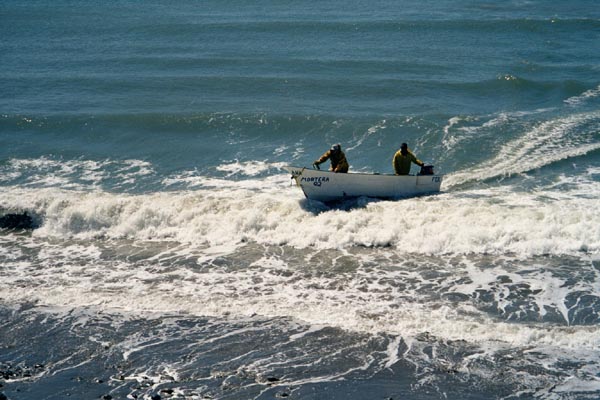
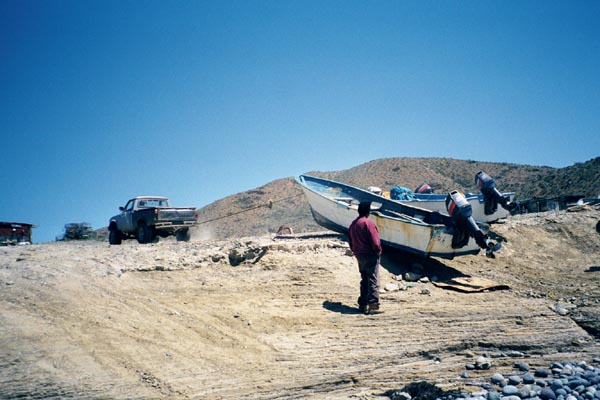
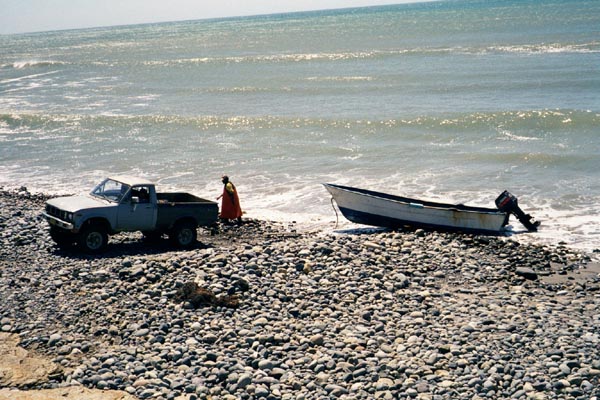
Before they left we watched how the locals here use their 4x4 “pickup” to haul boats down to and out of the surf instead of blasting up the berm. Here the beach is shallower and the cliff higher. Long lines are pulled down to the boats as they arrive and trucks on the floor of the arroyo pull them up. The next morning at low tide they picked the larger rocks off the beach and tossed them aside. Then the pickups drove down the cliff and dragged boats down the cobble, across the exposed sand, and right into the water. Most of the trucks have bodies rotting from the bottom up. Our host’s truck was in better shape because he and his family pushed the boat by hand as far as possible. When it gets stuck he shoves it from behind with the rear bumper of the truck to keep as far from the corrosive water as possible. He told us that until a few years ago his beach was all sand with no rocks.