Walk-On Beach is a beach in Sea Ranch that I have never taken off from or landed on. I padded past it only once on my way from Shell Beach to Gualala Beach. I decided to drive all the way up here to paddle because I didn't feel I had fully explored this area. I could go south to Shell Beach, a little farther to try and catch a picture in better light of a fantastic suspended deck I have seen before. This would only be a 6 kilometer trip so if I had more time I could go north to the Gualala Point Rock. The NOAA WEB site was reporting 3 foot swells, so it would be a good day for exploring nooks and crannies between rocks. To take pictures of the deck I left late in the afternoon, around 2:00 PM, and didn't actually get to the beach until around 4:00 PM.
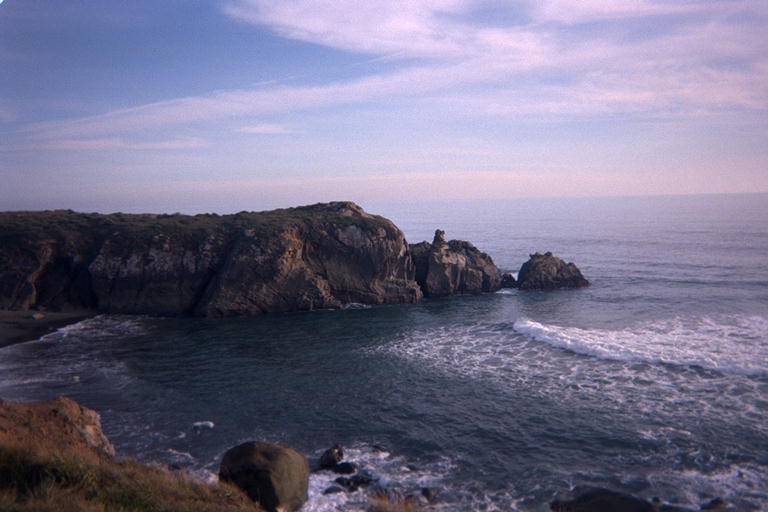
This beach has a trail leading down a little hill, over a road, out to the coast, and along the bluff top trail for a few hundred more meters before you get to the stairs. The trail goes over the next point to a larger beach. The first little beach had scary waves breaking into it, but they were centrally located and calmed down before getting to shore. It looked like I could get in the water against the rocky point on the south, crab north across the beach in the mild part of the breakers, and head out to sea between two rocks north of where the large breakers started. The waves were breaking towards the north side of the beach so there was also a calm zone along the south point with no breakers all the way out to sea, but there were fishermen casting lines into this. When I got into the water the calm zone looked more attractive than fighting across the breakers so I paddled closer to the fishermen. It turned out to be wide enough for both me and the fishing lines, so I made it out to sea with no problems.
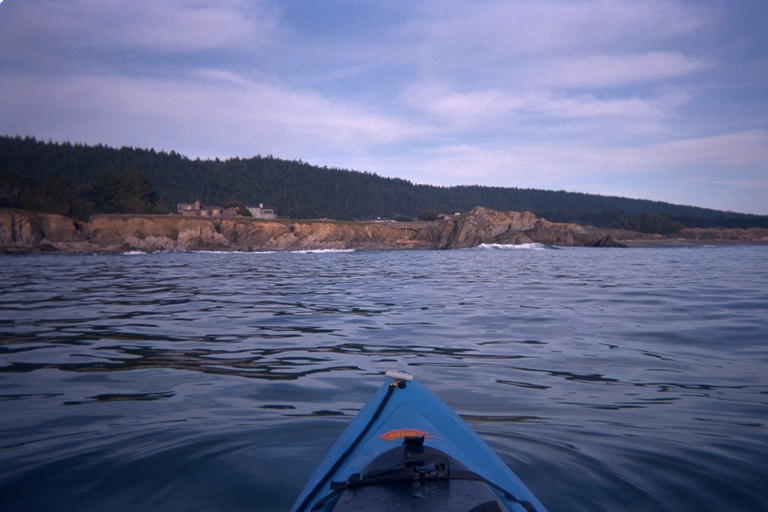
Heading south, I paddled behind every other rock I saw. I skipped the between ones only because they had harbor seals hauled out on them. This didn't stop the seals from panicking and charging into the water most times. Even when I was over 100 meters away and paddling away from them to go the long way around a rock. Calling these rocks may not give you the right impression. A great deal of the shore here had these flat-topped rocky areas sticking only a meter or so up out of the water. At high tide, the water probably covers these rocks, and the waves and breakers must be fierce. These areas are often separated from the shore by ten meters or so and in these calm waters I could travel around between the beach and the rocks. Then there were "canals" through the middle, but that was also where I saw the largest number of harbor seals and tried to stay away. Past Shell Beach, when I got to the cove with the deck hanging over it, I paddled between two rocks with a wave chasing me and a third rock in front of me that I wanted to avoid. So I zoomed around a rock and coasted within 5 meters of a half a dozen basking harbor seals. I stopped paddling and covered my eyes, but the seals didn't buy it and dove for the water. I held my hands out, shrugged my shoulders, and shouted "Sorry!" to some people who were watching from the cliff trail. They apparently heard me and shouted back something that could have been "You couldn't have known".
A couple times I got too close to the breakers and had to brace into them to keep from being turned over or pushed towards the rocks. Because of my surfing practice at Stump Beach I was ready for this. But the last two times I have gone out in this kayak, my upper arms have been sore in places they have never been sore before. It could be from the extra effort it takes to turn this longer kayak quickly in the water. But this boat accelerates faster than my little one, so I have the option of zooming out of trouble instead of just turning into it.
I recently had a medical checkup, and told my doctor that I had been getting more exercise in the last few years because I was out sea kayaking. Dr. Drier had never heard of anyone talking about kayaking being aerobic. Spending a few hours a week on the water doesn't count, she said, unless I get my pulse up to 120 beats per minute for at least 15 of those minutes. Every exercise she was familiar with involved the legs, and I had to admit my legs were not getting ANY exercise in this sport. I figured the exploration part of every trip, nosing the kayak behind every rock, would not be aerobic. But when I paddle straight back from point-to-point to get back to the car I always push hard. That probably gives me the aerobic exercise my doctor wants to hear me get. While I was paddling around the rocks at Shell Beach, I paused to measure my pulse with the stopwatch in my newly replaced waterproof watch. (Firmly attached to my life vest with a piece of cord this time). I usually have trouble finding my pulse, but Dr. Drier assured me it would be much easier to find if I was exercising. Sure enough I found my pulse in my neck, but wasn't sure what I was counting. I counted around 120 a minute but if I was counting both halves of the beat I was still at a resting pace. On the way back past Shell Beach while pushing hard, I paused to measure my pulse again. This time I definitely got 120 per minute. I think it was up there even on the exploratory phase of the trip. That means I get at least an hour of aerobic exercise every time I go out on the water. Baring waves, rocks, and sharks, I just might live long enough for nanotech to kick in. Then I'll get to live forever, or at least until the big party at the end of time just before the Big Crunch (the other side of the Big Bang at the end of Space/Time) happens.
I approached Walk-On Beach with some trepidation. If the rise in the tide had changed the topology too much, or if the waves were higher, the calm zone I paddled out through might be gone. It looked like it was still there, but a large wave might break across the point. This was scary because to hit the calm zone I had to paddle straight towards the rocky point with the unnerving sound of the waves breaking behind me and passing me on the left. Then when I got close to the rocks I jogged left and paddled along the rocky side of the point to an easy and safe landing.
Another explanation for my sore upper arms could be from the extra effort of dragging 10 more pounds of kayak out to the beach and back up the trail. This trip out I slid the kayak down the trail most of the way, and a longer kayak resulted in more friction and more tugging on my arms. Measuring my pulse on the way back up the trail, I found this also meets the requirement for aerobic exercise. Sliding the kayak also put the first set of scratches in it when I went over the dry sections of the trail. Now its no longer "New"! It was enough trouble getting the big kayak here, however, that I'll definitely bring the small one if I ever come out to this beach again.
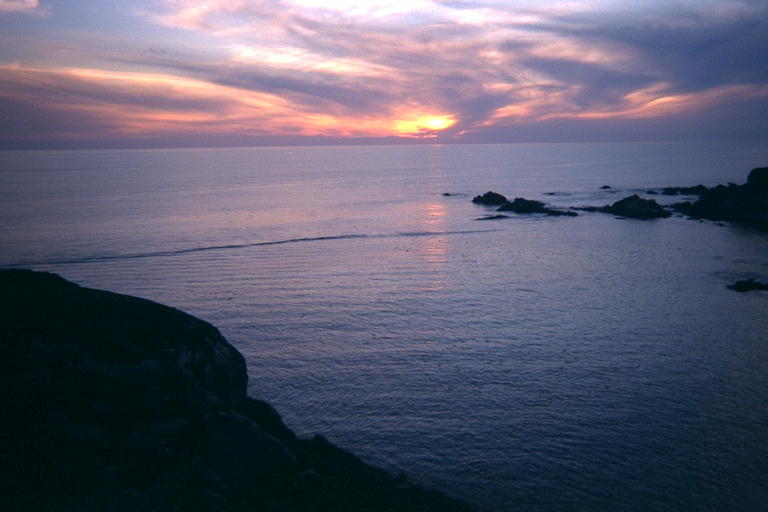
As I drove back down the coast the sun was close to setting and the sea calmed down even more than it had been all afternoon. It looked to me like the swells were only 1 foot at sea. But I saw what looked like one large long wave hanging off the coast. As I drove south, I kept getting glimpses of this one wave out there, and it didn't seem to be moving towards shore. I pulled over at a little cove south of Timber Cove to look at the sea. For a while I thought my strange wave was the edge of a tidal current. But I finally noticed that it was getting closer to shore and coming into the little cove I was parked above. As it came into the cove it disappeared where it touched the rocky points without breaking over any of the rocks. There was someone walking on the beach in the end of the cove and I wondered if my wave was going to rise up and grab them. But when it got to shore my strange wave was three little waves that rose up together and broke only inches higher than the rest of the waves.